


We were halfway through dinner when someone asked me to look back.
It was the day after my birthday, and the table was full of people who have known me across many versions of my life. At some point between the appetizers and dessert, Amina leaned forward and said gently, “How do you even think about this past year?”
I set down my fork. Just days after my birthday last year, my husband was diagnosed with leukemia, and everything since then has felt slightly off-axis, as if life tilted and never quite returned to level ground. There was no neat answer to her question, no summary that could do justice to the fear, the strange stretches of calm, the way time seemed to stretch and then snap back.
“I don’t know,” I said. “It’s hard to put into words.”
“What about him?” someone else asked, not unkindly. “How has this changed him? How has it changed your family?”
I found myself talking about things I hadn’t planned to say. Not the big moments, but the quiet revisions to everyday life.
For most of our marriage, we barely marked time. Birthdays passed with a mumbled acknowledgment, maybe a card left on the counter. Anniversaries slipped by unobserved. The children’s birthdays I managed and insisted on. Those we celebrated, because childhood deserves its ceremonies. But for us, days bled into one another, undifferentiated and unremarkable.
A few years ago, I put my foot down. Maybe it was a meltdown. Maybe it was clarity breaking through like light through a crack.
“We have to start commemorating the special moments,” I told him one evening after another forgotten anniversary had come and gone. “Otherwise, what is life about if we let each day dissolve into the next without marking where we’ve been?”
He looked up from his laptop, not quite understanding why it mattered so much to me, why we needed to celebrate at all.
The change came slowly, grudgingly at first, like turning a rusty wheel. Birthdays began to involve cards, small gestures, attention paid. Anniversaries became occasions rather than dates we’d already flipped past. It felt forced for a while, performative in a way that made me wonder if I’d asked for something artificial, something that couldn’t take root in soil that had gone hard from neglect.
But this year, something shifted.
This year, my birthday arrived with flowers he’d chosen himself, a dinner he’d arranged with kanafe and ice cream for dessert, a favorite. He has realized now that even this is a space for creative investment, that the choosing matters as much as the gesture itself. Our daughter Zaynab presented me with a two-tier Jellycat cake she’d made, a little smiling face on top with tiny feet sticking out the bottom, as if the cake were sitting there pleased with itself. Mikael gave me a small standing crocheted ice cream cone that reads, life is better with a sprinkle of you in it. Coming from Mikael, I knew each word was laden with intent and emotion. They sang to me, badly and joyfully, and when I looked at their faces, I saw recognition there. Perhaps even an admission that I had been right all along. That it was worth it. That marking time is not vanity, but survival.
“You see?” I wanted to say, but didn’t need to.
At the dinner table with friends, I tried to explain this.
“Before all of this, there were other patterns that felt just as fixed,” I said, reaching for my water glass. “Eesa would ask his dad to throw a football around or do something physical together. Not a big commitment. Just time.”
“And?” Amina prompted.
“More often than not, the answer was no,” I said. “Too tired. Too much going on. Another task still unfinished in his head.”
I remembered watching Eesa’s face close over when his father said, “Maybe later, buddy,” without looking up from his phone. I remembered how affection, too, had its limits. How my husband would joke that I held his hand too tightly in public, as if handholding felt conspicuous, unnecessary. We loved each other, of course, but love lived efficiently then, tucked between obligations like receipts filed in a drawer. I didn’t expect interruptions. I didn’t expect him to wander into my office and lean down to kiss the top of my head while I was absorbed in my work, because that kind of softness wasn’t part of the rhythm we had established over years of practical coexistence.
This is not a story about what he failed to do. I cannot fully know what he was carrying then. His workload was immense, the stress constant and compounding. When you are under that kind of pressure, the world narrows to a pinpoint of necessity. You move forward with blinders on, focused on holding everything together. Stress doesn’t just exhaust you. It quietly teaches you what to overlook, and sometimes who.
What illness did was interrupt those grooves with the force of a record scratch.
“Now, instead of tossing a football for ten distracted minutes, he goes to the gym with Eesa almost every day,” I said. I see them leave together in the morning, my husband’s hand resting on our son’s shoulder as they head out the door. It’s not performative or forced. It’s become theirs, a space they’ve built together out of repetition and shared effort and presence. They lift weights. They talk, or sometimes they don’t. They just exist side by side in a way that feels deeper than anything I’d seen before, maybe deeper than what was possible before their bond was tested by the possibility of its ending.
And the affection I didn’t expect has arrived anyway, unannounced, naturalizing itself into our days. A hand reaching for mine without calculation. A casual touch as he passes by my desk. Last week, he came into my office while I was on a deadline, said nothing, kissed the top of my head, and left. As if to say that he sees me in this moment too. As if to say that I am not background.
The birthdays now feel natural, woven into the fabric of who we are rather than stitched on awkwardly. The anniversaries land with weight because we understand, finally, that time is not infinite, that we cannot assume there will always be another year to get it right.
Around the table, people nodded. I could see it in their faces, a kind of wonderment mixed with understanding, as if they were witnessing something they recognized but hadn’t quite known how to name.
“There was no grand reckoning,” I continued. “No speech about priorities.” Just a gradual shift in where his attention rests, a slow learning that celebration is not frivolity but witness. A way of saying that this day will not pass unmarked, that this person will not go unseen, that this moment, right here, matters.
What it feels like, from inside the family, is a change in casting. We are no longer background figures orbiting a demanding professional life, no longer the supporting infrastructure that makes everything else possible. We are the main scene, the story he is choosing to live inside.
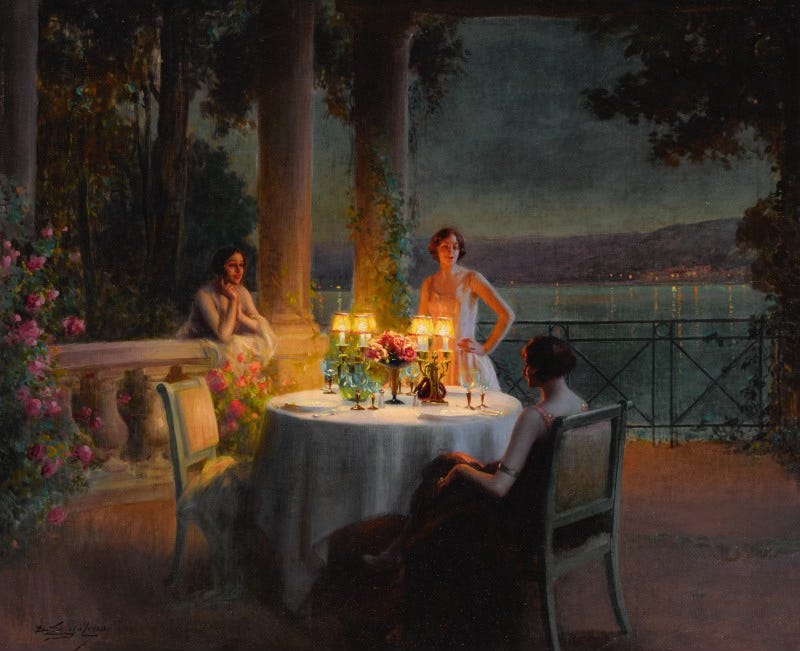
Someone refilled my water glass. Across the table, candles flickered in their holders, small fires marking this evening as different from all the others that came before.
Caregiving has taught me that this is how lives change. It teaches you that to mark time is to honor it, and to honor time is to say that we were alive here, together, and we saw it. We did not let it slip past unmarked. We did not take it for granted.
At that birthday table, surrounded by friends who have watched this year from a distance, I realized that illness has not only exposed fragility, but clarified center. It has redrawn the floor plan of our life, pulling certain rooms forward and closing off others we once mistook for essential.
Care does that. It rearranges the architecture. It reveals where life is really being lived.