


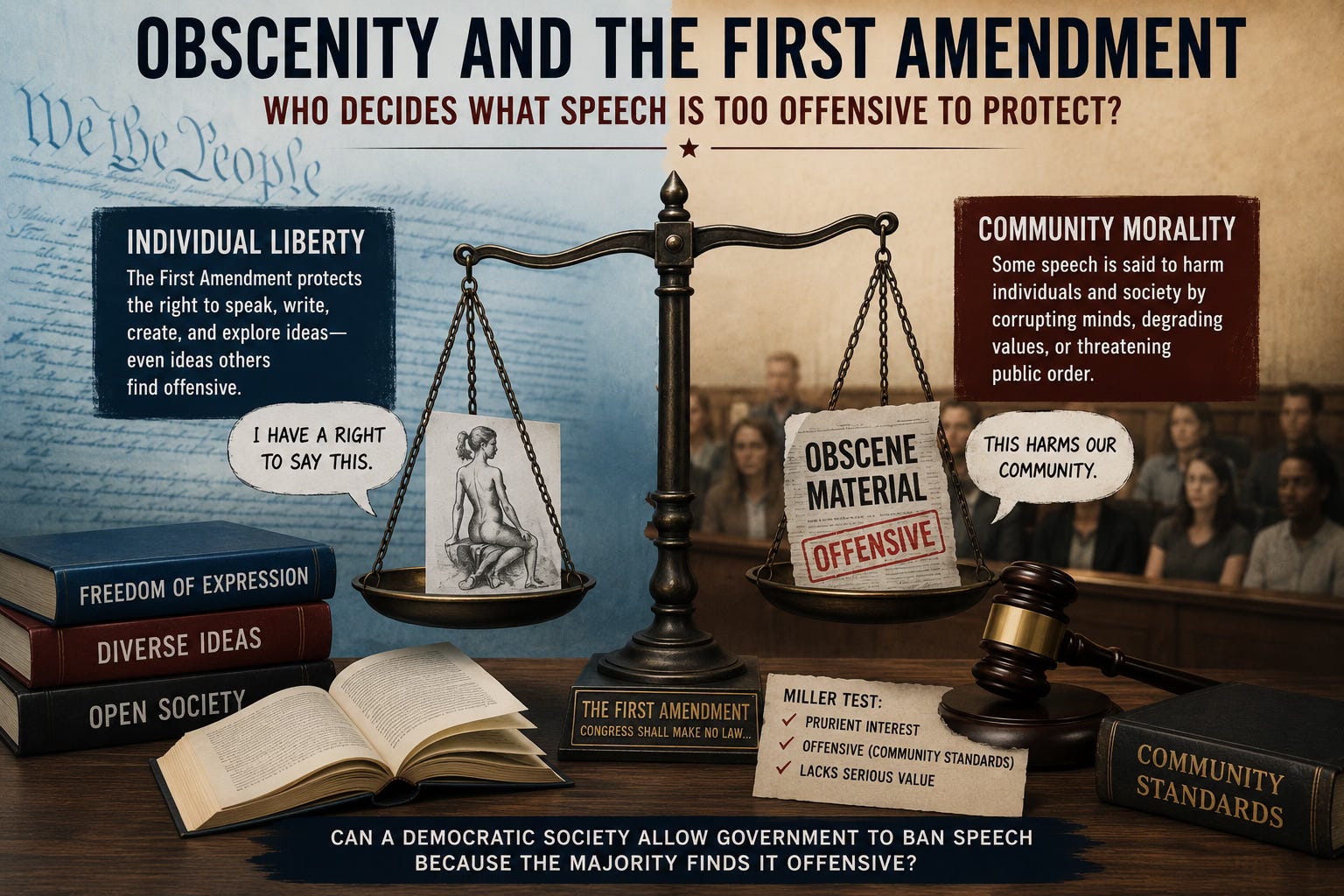
Watch this panel featuring Geoffrey Stone (University of Chicago), Martin Redish (Northwestern), and Amy Adler (NYU) on the history and constitutional status of obscenity. Stone traces the historical development of obscenity law, while Redish argues that obscenity’s exclusion from First Amendment protection is both historically unsupported and theoretically inconsistent with the core principles of free speech.
A few questions I want you to reflect on:
Redish argues that obscenity laws are fundamentally a form of viewpoint discrimination because they rest on government judgments about the proper role of sexuality and morality. Do you agree that obscenity laws regulate ideas about sex rather than merely explicit content, or is there a meaningful distinction between the two?
Stone contends that obscenity regulation has much shallower historical roots than many assume and that widespread sexual expression existed long before modern obscenity law. If that history is accurate, should it matter to how we interpret the First Amendment today? Why or why not?
The Miller test asks juries to apply “contemporary community standards” in determining what counts as obscenity. Does relying on community standards appropriately reflect democratic self-government, or does it simply allow majorities to suppress speech they find offensive?
Redish argues that the First Amendment exists precisely because government should not decide what expression is valuable, meaningful, or worthwhile. If speech can be excluded because it lacks “serious literary, artistic, political, or scientific value,” who should decide what has value—the courts, juries, legislatures, or the public itself?
Throughout the discussion, the speakers distinguish between speech that directly harms others (such as true threats or child pornography) and sexually explicit expression involving consenting adults. After watching the panel, do you think obscenity is best understood as a category of harmful conduct, or as protected expression that many people simply find morally objectionable? What constitutional principle leads you to that conclusion?