


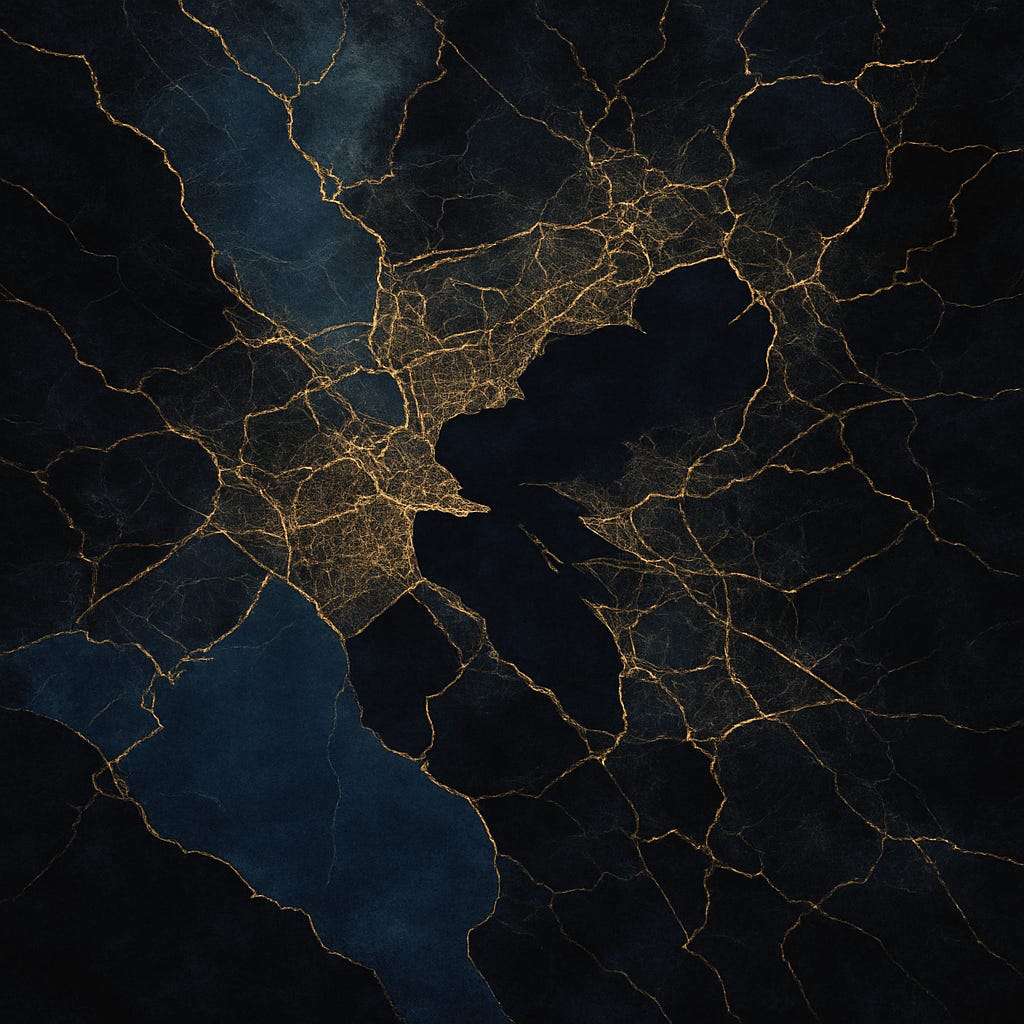
We talk about the loneliness epidemic like it’s abstract. But it’s not.
There is a map of loneliness that no cartographer has ever drawn, though we navigate it daily. You can see it in hospital rooms that echo too loud. In bedsides with no visitors. In nurses who linger longer than necessary because no one else has shown up all week.
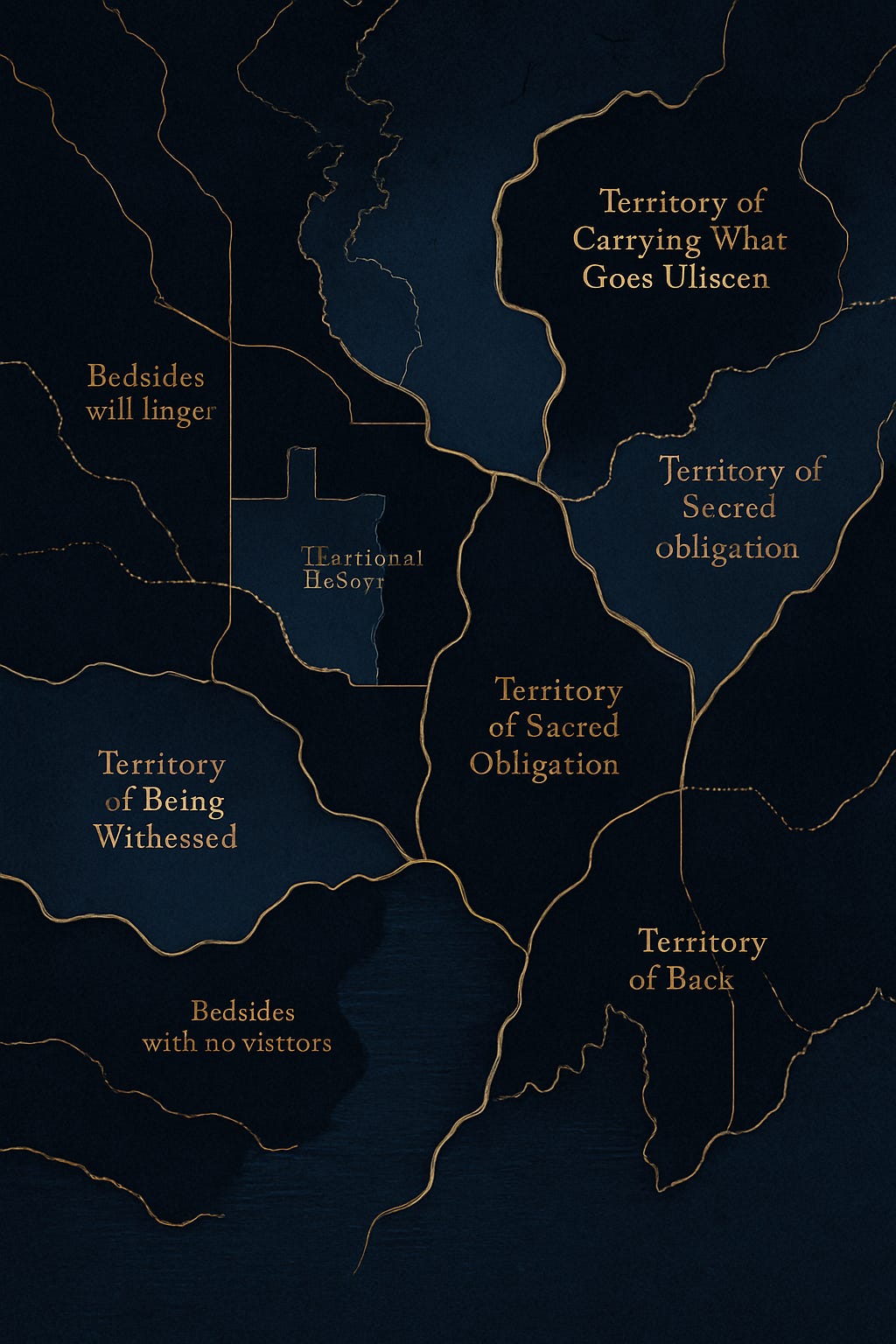
This is a map of invisibility—territories where suffering goes unseen, where people carry burdens that never make it into our conversations or our care. But it’s also a map of connection, where small acts of witness can redraw entire landscapes of isolation. The difference between these territories isn’t geography. It’s design.
I learned to read this map the hard way, during the months when my husband Shabbir was first hospitalized for cancer treatment. What I discovered was that we all live somewhere on this map, but most of us don’t know our coordinates until crisis forces us to look up from our daily routines and notice: Where am I? Who else is here? And who is missing entirely?
The Territory of Being Witnessed
The first week of Shabbir’s hospitalization, our front porch became something else entirely—an altar of attention where friends redrew the boundaries of our isolation. I had always thought of our porch as simply functional, a place to stack Amazon packages and shake out rugs. But suddenly it became a landmark on the map of care, a coordinates where love could find us.
Each gift that arrived felt like a pin dropped on this new geography of connection. Cake pops for Mikael arrived tucked in a box with star-shaped sprinkles—someone had remembered that seven-year-olds still believe in magic, even when their fathers are sick. A basket filled with dates for iftar, a candle scented with olive leaf and oud, and a child-size prayer rug—soft, jet black, with gold tassels. The person who left it understood something about the terrain we were crossing: that sometimes you need to create sacred space in the most sterile places.
What followed felt like its own form of navigation, breadcrumbs leading us back to connection when we might have otherwise gotten lost in the wilderness of medical terminology and insurance forms. Sarah’s sourdough arrived in professional bakery bags, though she’d baked every loaf herself—walnut cranberry one week, jalapeño cheddar the next—each delivery still warm and fragrant with the particular comfort of someone else’s kitchen. Amina’s homemade butter and jam, evidence that someone had been thinking of us while churning and stirring. Sophia’s cardamom tea, steeped in the silence of someone who understood that sometimes the best thing you can offer is flavor when everything else tastes like fear.
None of it was grand, but all of it was attentive. Not the kind of help you Google (“What do you bring someone with cancer?”) but the kind that comes from having been there, from understanding the small indignities and unexpected needs that crater the landscape of illness. The kind that reorients us toward each other when the gravitational pull of isolation threatens to scatter us into separate orbits.
This quiet web of care reminded me how rare it is to be truly held. And how easy it is to miss who isn’t.
The Territory of Abandonment
Down the hall from Shabbir lived another geography entirely, a place where the map showed only empty space, unmarked by human presence. If care leaves traces like breadcrumbs, abandonment leaves something else: the echo of footsteps that never came, the outline of visits that never happened.
A woman in the room next to his could be heard wailing at random intervals throughout the day—calling, pleading with the empty air. Her voice would rise and fall like a tide, sometimes forming words, sometimes dissolving into something more primal. Her door remained half closed, the hallway outside perpetually empty, as if her grief had created its own force field that repelled visitors.
No get-well cards littered her windowsill. No personal items cluttered her bedside table—no photos propped against the water pitcher, no books spine-cracked from being read by someone who cared enough to choose them. Just the standard-issue hospital blanket, pulled tight to her chin, and a water pitcher that the nurses refilled because no one else was there to notice it was empty.
I found myself timing my walks around her cries, unable to bear the sound but also unable to stop listening. There was something about the regularity of her solitude that felt systematic, predictable, as if loneliness had its own inexorable rhythm..
Not a single visitor came in and out of her room the whole month Shabbir was first hospitalized. When he went back in for his second round of chemo three weeks later, she was still there, still wailing, still alone. Her room had become an island in the truest sense: surrounded on all sides by an ocean too wide to cross.
Another evening, I heard a man shouting in terror, dragging his IV pole as he stumbled down the hallway. “Someone get me out of here!” he cried, his voice cracking against the fluorescent lights. The words echoed against the linoleum floors, bouncing off walls that had heard it all before. His terror was specific—not just fear of illness, but fear of facing it alone, of disappearing into the kind of medical anonymity where your name becomes a room number and your pain becomes a chart notation.
Later, a nurse told me he’d been there six days with no visitors. “Some people just go through this alone,” she said, not unkindly, just plainly, as if it were weather. As if abandonment were a natural phenomenon rather than a choice, a series of small decisions that accumulate into vast territories of isolation.
But it’s not weather. It’s design.
The Architecture of Isolation
What creates these territories of abandonment? It’s not accidental geography. It’s the deliberate architecture of a culture that has organized itself around individual competence rather than collective care, around the myth that needing help is weakness rather than the most human thing we do.
We’ve built healthcare systems that prioritize efficiency over connection, where “patient throughput” matters more than whether someone dies alone, where visiting hours are designed around staff schedules rather than human need.
We’ve created economic structures that scatter families across time zones like seeds in the wind, then wonder why grandparents languish in facilities with no visitors, why adult children feel guilty for living too far away to help, why the geography of economic opportunity rarely overlaps with the geography of care. The American Dream promised mobility, but it delivered isolation—the freedom to go anywhere coupled with the loneliness of having no one to call when you need help.
We’ve designed neighborhoods where you can live next to someone for decades without learning their name, where privacy is valued more than connection, where the architecture of suburban life—high fences, attached garages, closed blinds—creates physical barriers that mirror emotional ones. I realized this in a former home, when I tried to think of which neighbors I could call in an emergency and, after eleven years in the same house, came up with almost no one.
Our digital culture compounds this isolation, mistaking information for intimacy and performance for presence. We scroll through curated lives while collapsing quietly off-screen, each of us believing we’re the only one struggling because everyone else’s highlight reel looks so polished. We’ve built a world where you can have 500 friends on Facebook and still die alone in a hospital room, where connection feels abundant and available but presence feels rare and precious.
This isn’t just about individual choices—though those matter. It’s about systems that make care optional rather than integral, that treat presence as a luxury rather than a necessity, that mistake privacy for dignity and independence for worth. We’ve created a culture where asking for help feels like failure, where admitting you need support feels like weakness, where the people who are drowning learn to do it quietly so as not to bother anyone.
The map of care isn’t just about who shows up. It’s about who feels permitted to show up, who has the time and resources to show up, who knows how to navigate the terrain of another person’s suffering without making it about themselves. It’s about the invisible boundaries that keep people from reaching across the space between self and other, the unspoken rules that govern when care is appropriate and when it’s intrusive.
The Weight of the Invisible
When I published The Weight You Can’t See, I expected a few kind replies from people who knew us, maybe some hearts on social media, the usual gentle acknowledgments that pass for support in our digitally mediated world. Instead, I was flooded with messages—evidence that people had been waiting years, sometimes decades, for someone to name what they were carrying.
The response felt like a dam breaking, like I had accidentally given people permission to speak about territories of experience that had been unmapped in our usual conversations. That phrase, “feel seen,” appeared in message after message, as if visibility itself had become a rare commodity. Women wrote about caring for in-laws, navigating a husband’s brain surgery, managing the isolation of caregiving that made them question their own reality. Each described the same topology of fear and endurance—the sleepless nights, the way children grow up too fast when crisis visits, the peculiar strength that emerges when you have no choice but to keep going.
But one response stopped me cold. A mother of a child with autism wrote about “stepping back into nearly 10 years of writing our autism family truths,” how my words had helped her recognize patterns she’d been living but not naming: “the threads of being everyone’s caregiver, wanting time for yourself and feeling guilty about it, seeing our kids step up in unexpected ways—all so familiar. The unbearable lightness of the weight we learn to carry. The ease creeps up in ways in which we never expected such that when we recognize it, it feels alien.”
That phrase—“the unbearable lightness of the weight we learn to carry”—captured something I was still learning to understand: how you adapt to carrying what feels impossible until it becomes so much a part of you that you forget you’re carrying it at all. How the weight becomes invisible even to yourself, until someone names it and suddenly you remember: oh yes, I have been carrying this enormous thing.
What struck me wasn’t just that they related—it was that they were waiting for someone to name it. The isolation isn’t just about being alone. It’s about carrying experiences that have no language, no social scripts, no cultural recognition. These are the unmapped territories of our social landscape, places where people navigate profound experiences entirely alone, not because they lack relationships, but because those relationships lack the vocabulary or permission to enter difficult spaces.
The Territory of Sacred Obligation
But there are other territories on this map, places where care isn’t left to chance or good intentions. In some communities, presence isn’t optional—it’s woven into the fabric of social expectation, as fundamental as showing up for work or feeding your children.
I learned this from the Islamic teaching that says when you visit the sick, you are surrounded by mercy, that to walk toward someone in need is to walk a path through paradise. Whether or not you believe that literally, the framing matters: care is not extra. It’s expected. It’s sacred. Not because it fixes anything, but because it refuses to let suffering happen unseen.
This represents a fundamentally different map, one where care is infrastructure rather than charity, where showing up becomes as automatic as responding to a smoke alarm because we understand that abandonment, like fire, spreads quickly through the structures we’ve built. In these territories, the question isn’t “Should I visit?” but “When will I visit?” The pathways are already drawn.
But even within communities that value care, the geography can be uneven. Some people live at the center of networks of attention, while others exist at the periphery, their suffering noted but not necessarily witnessed. The difference often comes down to factors that have nothing to do with need: social capital, family structure, personality, the simple luck of being well-connected when crisis hits.
Learning to Navigate
The strange thing about the geography of care is that you can live in it for years without knowing how to read it. Before Shabbir’s diagnosis, I lived in the comfortable territory of the temporarily unafflicted—that vast middle ground where you assume crisis happens to other people, where you offer help when asked, check in when convenient. I thought I understood community care because I participated in it occasionally, the way someone might think they understand a foreign country because they’ve stayed in its hotels.
But witnessing both profound connection and profound abandonment in the same hallway, sometimes in the same day, changed something fundamental about how I navigate the world. I started to see the invisible infrastructure of care—who has it, who doesn’t, and why. I began to recognize the landmarks of different territories: the way someone’s voice changes when they’re carrying something heavy, the particular quality of silence that surrounds unwitnessed suffering, the small gestures that signal whether someone is part of a network of care or adrift in the vast ocean of managing alone.
Even more importantly, I learned to see the borders between territories, the invisible lines that separate those who are held from those who are forgotten. These borders aren’t always about geography or economics or social class, though those factors matter. Sometimes they’re about something more subtle: the difference between communities that see care as occasional charity and communities that see it as continuous obligation, between cultures that value independence above all else and cultures that understand interdependence as fundamental to human flourishing.
The map of loneliness is real, drawn in the space between those who are witnessed and those who disappear, and once you learn to read it, you can never stop seeing it.
What territory do you find yourself in today? And who around you might be calling out to empty air?