


On Saturday, at a town hall in Caro, Michigan, a man in the crowd called out to Abdul El-Sayed, the Democratic nominee for the U.S. Senate: “Will you disavow the Muslim Brotherhood?”
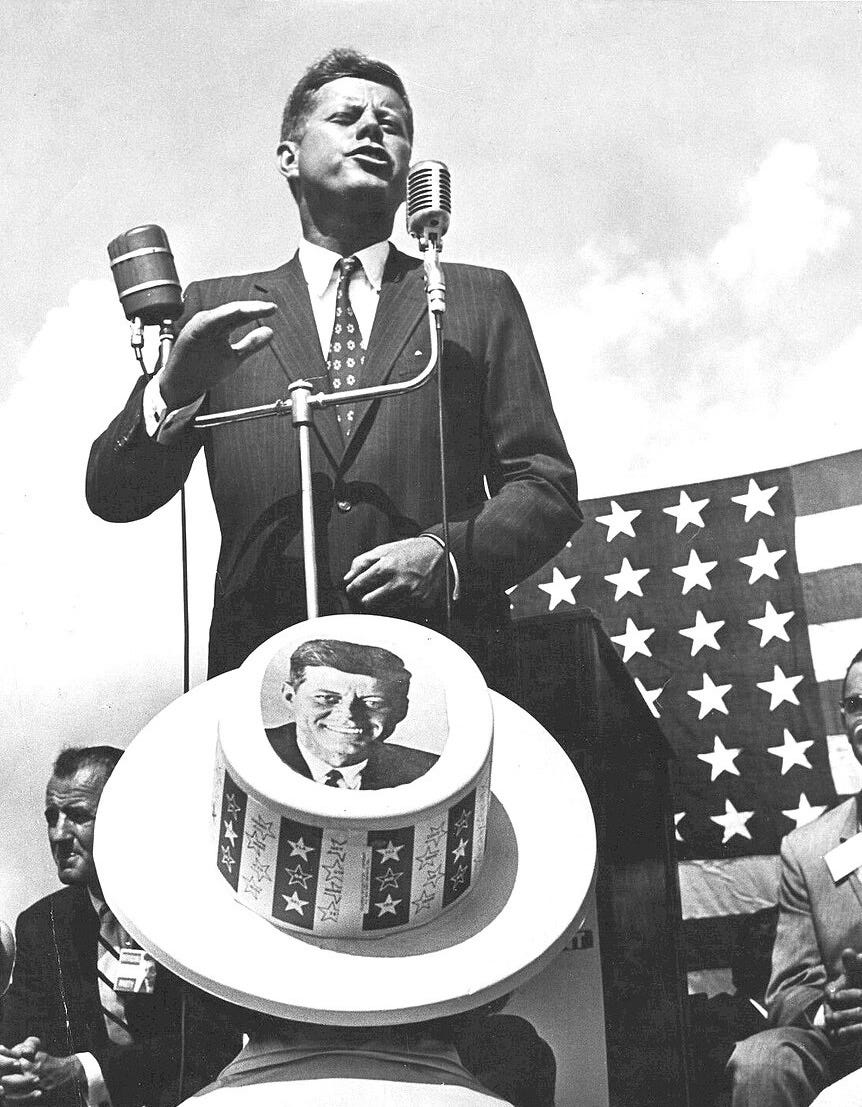
After some back-and-forth, El-Sayed said, “Sure, yeah, absolutely.” Then he named the assumption behind the question. “You assume . . . that because I am Muslim, that somehow I would have some allegiance to something that is not our Constitution,” he said. He reminded the room that John F. Kennedy faced the same suspicion as a Catholic.
Then El-Sayed asked a question of his own. Would the man disavow any attempt to read religious doctrine into American law?
“I do not,” the man said.
I have spent my career on questions like this one, first as a religious liberty lawyer and now teaching constitutional law at Michigan State, less than two hours from Caro. Kennedy’s election was supposed to settle whether a member of a minority faith could be trusted with national power. Sixty-six years later, a Muslim candidate is still being asked to prove it, and he faces a problem Kennedy never did.
Who was asking
The man gave his name only as Tommy. Several outlets have identified him as Thomas Teepell, who worked for Senator Josh Hawley until February. Early in my career, I worked briefly alongside Hawley at the Becket Fund for Religious Liberty. Becket’s premise is that religious liberty is indivisible: the principle that protects a Catholic charity also protects a Muslim prisoner who wants to grow a beard. I don’t hold a senator responsible for a former aide’s views. But Tommy’s question treated El-Sayed’s religion as evidence of disloyalty, and that is precisely what the principle forbids.
Nor was the question a one-off. Two days earlier, President Trump called El-Sayed “a Muslim Brotherhood guy, 100%.” The day after the town hall, his opponent, Mike Rogers, told CNN that El-Sayed “didn’t disavow it,” though the video shows he did.
No pope to renounce
Article VI of the Constitution bans religious tests for federal office. It binds the government, not voters, who may weigh a candidate’s faith however they like. The clause reflects a judgment that religious identity should not decide who can be trusted with power. A country can comply with that rule and still betray the principle behind it at the ballot box.
Kennedy confronted exactly that in 1960, when many Americans feared a Catholic president would take orders from Rome. In a speech to Protestant ministers in Houston, he promised to decide every issue “without regard to outside religious pressures or dictates.” He did not renounce his conscience. He renounced the Vatican’s authority over him. He could do that because the fear had a specific object.
El-Sayed has no such option, because the suspicion he faces attaches to Islam itself. What must a Muslim candidate disavow to prove that Islam will not govern through him? El-Sayed disavowed the Brotherhood and was still told he hadn’t. Each answer only invites the next demand.
Rogers explained the logic. “This is about the way you think, not the way you pray,” he told CNN. “This is about your ideology.”
That is the move I spent a book documenting. In When Islam Is Not a Religion (2019), I traced how opponents of mosques and backers of anti-Sharia laws recast Islam as a political ideology rather than a faith. Once Islam is defined as politics, ordinary Muslim life becomes evidence of a threat, and opponents can argue that the Constitution’s protections for religion should not apply. When a Christian politician invokes faith, we call it conscience. When a politician is Muslim, we go looking for a political program.
Fair questions and unfair ones
Voters may ask any candidate about any organization, the Brotherhood included. The real question is what counts as evidence. Membership, endorsements, or public statements supporting a group are fair game, for a candidate of any faith. A candidate’s religion is not. Neither, standing alone, is a relative’s alleged past.
By that standard, the case against El-Sayed is thin. Republicans point to social media posts by his half-sister claiming their mother was active in the Brotherhood in 1970s Egypt. Yet even Fox News reports that it “has not discovered any ties between El-Sayed and the Muslim Brotherhood.” We don’t usually hold candidates responsible for their relatives’ politics. The exception has long been minority faiths, where heritage becomes proof of divided loyalty. Jewish candidates know this charge well.
Christian candidates get asked about Christian nationalism, too. But Christianity alone is rarely treated as evidence of allegiance to it. Muslim identity can be enough to trigger suspicion, and even a disavowal may not dispel it. That is what makes this a religious test.
“I do not”
Which brings me back to Tommy’s answer. El-Sayed was expected to offer an immediate, unequivocal assurance that his faith posed no threat to the Constitution. Asked for his own assurance about religion and government, his questioner declined. The burden of proving loyalty rested entirely on the Muslim candidate.
Every fall, I teach the Religion Clauses to my law students. The first line we draw is the one El-Sayed drew. Faith may inform an official’s political judgment. What the Constitution forbids is government action that establishes religion or coerces religious observance. That is the standard I would apply to El-Sayed, to Rogers, and to every candidate of every faith.
Kennedy could promise that the pope would not govern through him. El-Sayed has no pope to renounce. All he can offer is his allegiance to the Constitution, and in Caro, he affirmed it.
He also asked one question that every candidate should have to answer. Tommy answered it in three words. Then he left the room.
If a candidate’s disavowal isn’t enough, what would be?